

Introduction
Pay per mile insurance (also called usage-based insurance) is reshaping how drivers pay for auto coverage. Instead of a flat monthly premium, your cost depends largely on how much you drive. For drivers who log below-average miles, this model can produce meaningful savings. This guide explains how pay per mile insurance works, what data insurers collect, who benefits most, the pros and cons, cost drivers, a comparison with traditional policies, a worked example calculator, and a thorough FAQ to help you decide whether pay-per-mile car insurance is right for you.
How pay per mile insurance works
Most pay per mile plans combine a fixed base fee with a variable per-mile charge. Insurers measure mileage using a telematics device plugged into your vehicle’s OBD-II port or a mobile app that records trips. Some programs also consider driving behavior (hard braking, rapid acceleration, speed, time of day) to adjust rates or offer discounts. Before purchasing a policy, you can review insurance resources and consumer information provided by the National Association of Insurance Commissioners (NAIC).
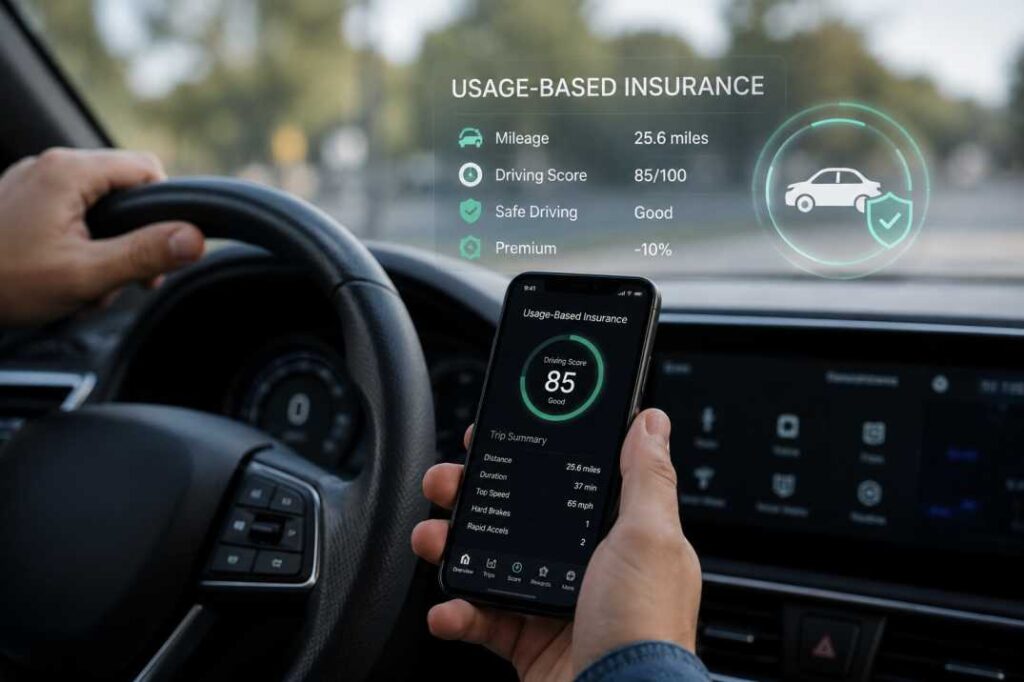
Typical pricing structure
- Base rate: fixed monthly charge that covers insurance availability and fixed administrative costs.
- Per-mile rate: a set cents-per-mile fee charged for each mile driven that billing period.
- Adjustments: discounts or surcharges based on driving behavior or driving score.
Data collection and privacy considerations
For additional information about auto insurance coverage and consumer guidance, visit the Insurance Information Institute (III).
Insurers may collect:
- Total miles driven
- Trip start/end times (day vs night driving)
- Speed and instances of speeding
- Hard braking and rapid acceleration events
- Location/route patterns (varies by program; some collect coarse data only)
Privacy tips:
- Read the insurer’s privacy policy: check data retention, sharing with third parties, and whether data is used for marketing.
- Ask if you can disconnect telematics when selling the car.
- Prefer programs offering anonymized or aggregated reporting.
Who benefits most from pay per mile insurance
- Low-mileage drivers: Occasional drivers and household secondary vehicles often see the biggest savings.
- City residents and commuters who use public transit.
- Remote workers and hybrid workers who commute infrequently.
- Part-time drivers, retirees, and students with limited driving.
Who should avoid pay per mile insurance
- High-mileage commuters and long-distance drivers.
- Drivers uncomfortable with continuous tracking.
- People in areas where program availability or competitive pricing is limited.
Comparing pay per mile vs traditional insurance
- Pricing: Traditional — fixed monthly/annual premium; Pay per mile — base fee + per-mile charge.
- Predictability: Traditional policies are predictable; pay per mile can vary month-to-month.
- Behavior incentives: Pay per mile encourages reduced driving and safer habits.
- Availability: Not all insurers and states offer pay per mile options.
Example comparison table
- Base monthly cost, per-mile rate, average monthly miles, monthly total for each policy.
Provider type | Base monthly fee | Per-mile rate | Example monthly miles | Estimated monthly cost
Comprehensive insurance | $80 | $0.00 | 1,000 | $80
Pay-per-mile insurer | $25 | $0.07 | 300 | $46
Pay-per-mile insurer | $25 | $0.07 | 1,200 | $109
Cost factors that affect your pay per mile premium
- Monthly and annual mileage
- Driving habits (hard braking, speeding)
- Vehicle make, model, and safety features
- Age, driving history, and credit (where allowed)
- Location: urban vs rural, theft and accident rates
- Time of day driving (night driving often increases risk)
Quick calculator: How to estimate your monthly cost
Step 1: Find your base monthly fee and per-mile rate from a provider (e.g., base $25, per-mile $0.07).
Step 2: Estimate average monthly miles. Example: you drive 12,000 miles/year = 1,000 miles/month.
Step 3: Calculate: Monthly cost = base fee + (per-mile rate × monthly miles).
Example calculation:
- Base fee = $25
- Per-mile = $0.07
- Monthly miles = 300
Monthly cost = $25 + (0.07 × 300) = $25 + $21 = $46
Worked annual comparison example
- Traditional annual premium = $960 ($80/month).
- Pay-per-mile annual: base $25 × 12 = $300; per-mile $0.07 × 3,600 miles = $252; total = $552.
Result: Pay per mile saves $408/year for a 3,600-mile driver in this example.
Tips to estimate your mileage
- Use your odometer: record current mileage and compare after a month.
- Use smartphone mapping history or Apple/Google location timeline to estimate typical monthly miles.
- Consider seasonal changes (vacations, commuting changes).
You can also explore how insurers offer mileage-based programs by visiting Progressive’s auto insurance information.

Pros and cons (detailed)
Advantages
- Lower costs for low-mileage drivers.
- Encourages safer driving, which may lead to discounts.
- Transparent link between usage and price.
Disadvantages
- Monthly cost can increase if mileage rises.
- Some drivers dislike continuous tracking.
- Not universally available; fewer options in some states.
- Potential for billing surprises if you underestimate driving.
How to compare offers effectively (step-by-step)
- Gather quotes from multiple providers — get both traditional and pay-per-mile quotes.
- Ask for breakdowns: base fee, per-mile rate, minimums, administrative fees.
- Calculate costs for different mileage scenarios (low, average, high).
- Check discounts: multi-car, safe driver, bundling with home insurance.
- Read privacy policies and telematics terms.
- Confirm cancellation terms and how data is handled after policy ends.
Real-world scenarios:
- Urban commuter who drives 150 miles/month: likely big savings with pay per mile.
- Suburban parent with weekend trips totaling 900 miles/month: savings depend on per-mile rate vs car insurance premium.
- Rideshare driver logging 3,000+ miles/month: traditional or specialized commercial policies likely cheaper.
Expanded FAQ (specific questions and answers)
Is pay per mile insurance cheaper?
- Often yes for low-mileage drivers, but it depends on the base fee and per-mile rate compared to traditional premiums.
Do I need a tracking device?
- Most programs use an OBD-II device or mobile app. Some insurers offer either option.
Will insurers track my location?
- Many collect trip start/stop and basic route info; however, some limit data to mileage only. Always check the privacy policy.
Can my rate increase mid-policy?
- Per-mile charges are billed based on reported miles; if you drive more than estimated, your monthly cost will increase. Some policies recalculate at renewal.
What if I sell my car or trade it in?
- Notify your insurer; you may be able to transfer or end the telematics agreement. Data retention policies vary.
Will a telematics program affect my claim?
- Telematics data can be used in claims investigations, and safe driving records can help secure discounts.
Are there minimum or maximum mileage requirements?
- Some plans include a minimum monthly charge or cap per period; verify with the provider.
Is pay per mile available in every state?
- Availability varies by insurer and state regulations. Check local providers.
How accurate are mileage recordings?
- OBD-II devices and app-based systems are generally accurate for mileage; expect small discrepancies due to GPS errors or data processing.
Does pay per mile work with electric vehicles?
- Yes. EVs can participate in pay-per-mile programs just like gasoline cars; sometimes insurers offer EV-specific discounts.
Common mistakes to avoid:
- Underestimating monthly miles when comparing plans.
- Ignoring privacy terms and data-sharing clauses.
- Failing to compare total annual costs, not just monthly rates.
Conclusion
Pay per mile insurance aligns cost with usage and appeals to low-mileage, city, and remote workers. Before making a final decision, it’s a good idea to compare different insurance providers to find the coverage and pricing that best fit your driving habits. It can produce meaningful savings when base fees and per-mile rates are competitive. Use the calculator above, gather multiple quotes, and review privacy terms before deciding.
About the Author