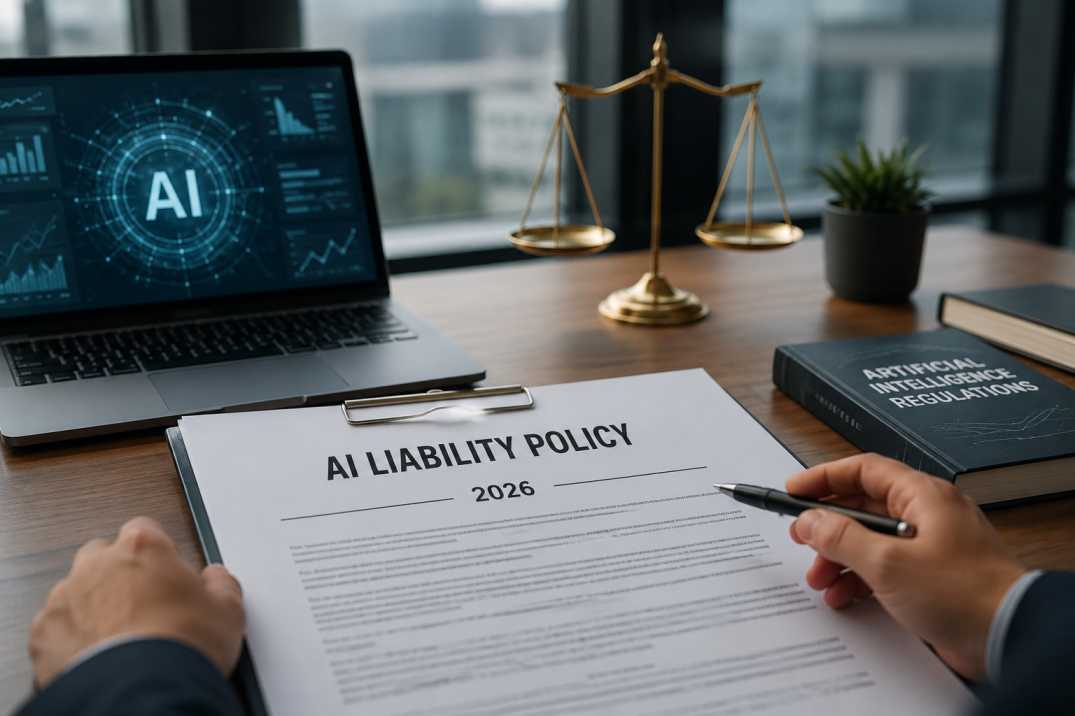
AI liability policy coverage is becoming an important issue for US tech startups. Moreover, as more companies build, sell, or use artificial intelligence and insurers are asking closer questions about model risk, data use, bias, privacy, and automated decisions.
However, standard cyber, general liability, and technology errors and omissions policies may not clearly cover every AI-related claim. As a result, a startup may believe it is protected, while the policy language leaves key AI risks unclear.
For this reason, founders, CTOs, and risk managers are reviewing standalone AI liability insurance. A dedicated policy may help address claims tied to model outputs, training data, discrimination, privacy and intellectual property, and AI governance.
What Is an AI Liability Policy?
An AI liability policy is specialized insurance for risks linked to artificial intelligence systems. Also, It may apply to machine learning models, generative AI tools, automated decision systems, predictive platforms, and AI-powered SaaS products.
Unlike a broad business policy, this coverage focuses on how AI systems behave. For example, it may respond when an AI tool produces a wrong, biased, unsafe, or disputed result.
Coverage may include:
- Algorithmic bias or discrimination claims
- Incorrect AI-generated advice or recommendations
- Privacy claims tied to model training or data use
- Copyright or licensing disputes involving AI-generated content
- Regulatory investigations related to AI governance
- Financial harm caused by automated decisions
- Legal defense costs, settlements, or judgments
However, every policy is different. Therefore, startups should review the exact wording before assuming a claim will be covered.
Why Standard Insurance May Not Be Enough
Many startups rely on cyber insurance, technology E&O, and general liability coverage. These policies still matter. However, they may not fully address AI-specific claims.
For example, cyber insurance may respond to a data breach. Yet it may not respond if an AI model creates a biased hiring recommendation. Similarly, technology E&O may cover a software error, but it may exclude certain AI outputs, unapproved model use, or content disputes.
In addition, insurers are asking more questions about AI during underwriting. Some may add exclusions. Others may offer limited endorsements. As a result, a standalone AI liability policy is becoming more relevant for startups with meaningful AI exposure.
Common AI Coverage Gaps
Coverage gaps can appear in several areas. For instance, a traditional policy may limit or exclude:
- Generative AI hallucinations
- Autonomous system failures
- Training data copyright disputes
- Unapproved AI tool usage
- Discrimination claims from automated decisions
- Regulatory penalties or investigations
- Third-party AI vendor failures
Because AI risk changes quickly, older policies may not keep pace. Therefore, a careful policy review is essential.
Which Startups Should Consider AI Liability Policy Insurance?
Not every startup needs a standalone policy right away. However, some companies face higher risk because their AI systems affect people, money, health, safety, legal rights, or business decisions.
Higher-Risk Startup Categories
- Generative AI platforms
- Fintech and insurtech companies
- Healthcare AI startups
- HR and hiring automation platforms
- Autonomous vehicle or robotics software companies
- AI cybersecurity providers
- Predictive analytics platforms
- AI-powered SaaS companies
If your product influences lending, insurance, healthcare, hiring, security, or customer decisions, your exposure may be higher. In that case, AI liability insurance may be worth reviewing with a qualified insurance broker.
Key Questions Before Buying an AI Liability Policy
Before buying coverage, startups should understand how AI is used across the business. Moreover these questions can help guide the review.
1. Do You Build AI or Only Use AI?
A startup does not need to build its own model to face liability. For example, a company may use a third-party AI tool inside its product. Even then, customers may still hold the startup responsible for the result.
2. What Data Trains or Powers the Model?
Training data matters. Public data, customer data, licensed data, and scraped data can all create different risks. Therefore, startups should document data sources, permissions, and usage limits.
3. Can AI Outputs Cause Financial Harm?
If users rely on AI recommendations, a wrong output may cause losses. Therefore, this risk is higher when AI affects investments, insurance pricing, credit decisions, medical triage, fraud detection, or legal workflows.
4. Do Clients Require Proof of Coverage?
Enterprise clients often ask vendors about cyber insurance, technology E&O, privacy controls, and AI governance. Increasingly, they may also ask whether AI-specific claims are covered.
5. Are Regulators Watching Your Industry?
As, US regulators are paying closer attention to AI transparency, fairness, privacy, and consumer harm. For additional context, startups can review guidance from the Federal Trade Commission and the NIST AI Risk Management Framework.
What Does AI Liability Policy Insurance Typically Cover?
Coverage varies by carrier. Still, many standalone policies combine parts of professional liability, media liability, privacy liability, and regulatory defense.
| Coverage Area | What It May Cover |
|---|---|
| Professional Liability | Claims from AI errors, failures, or inaccurate outputs |
| Bias and Discrimination | Claims tied to unfair automated decisions |
| Privacy Liability | Improper data collection, sharing, or model training allegations |
| Intellectual Property | Copyright, licensing, or content ownership disputes |
| Regulatory Defense | Defense costs for AI-related investigations |
| Media Liability | Defamation or content claims from AI-generated material |
In addition, some policies may include crisis support, incident response help, or risk management services. However, limits and exclusions can vary widely.
How Much Does an AI Liability Policy Cost?
The cost of an AI liability policy depends on the startup’s risk profile. therefore, Insurers may review revenue, industry, customer type, model use, data controls, and past claims.
For early-stage startups, premiums may start at a few thousand dollars per year. However, costs can rise quickly for companies in healthcare, finance, insurance, employment, or other regulated sectors.
Factors That Affect Premiums
- Type of AI model used
- Industry and regulatory exposure
- Annual revenue and customer volume
- Data privacy and security controls
- Human review procedures
- Model testing and monitoring
- Contractual liability requirements
- Claims history
Because underwriting is still evolving, startups should expect detailed questions. For example, insurers may ask for AI governance policies, testing records, and incident response plans.
AI Liability Policy vs Cyber Insurance
Cyber insurance and AI liability insurance can overlap, but they are not the same. Cyber insurance focuses mainly on data breaches, security events, ransomware, and privacy incidents. An AI liability policy focuses more on harm caused by AI systems and outputs.
| Risk Area | Cyber Insurance | AI Liability Policy |
|---|---|---|
| Data breach | Usually covered | Sometimes covered |
| AI bias claim | Often limited | Often included |
| Algorithm error | Often limited | Often included |
| AI regulatory investigation | May be limited | May be included |
| Generated content dispute | Often limited | May be included |
Therefore, startups should not assume one policy replaces the other. Instead, they should compare both policies and look for gaps, exclusions, and overlapping coverage.
How to Review AI liability Policy Language
Before choosing coverage, read the definitions, exclusions, endorsements, and claim examples. Also, ask the broker or carrier how the policy treats third-party AI tools, open-source models, copyrighted training data, and human review.
In addition, review contract requirements from enterprise clients. Some contracts may require cyber insurance, technology E&O, or specific professional liability limits. Therefore, the right coverage package may include more than one policy.
Final Thoughts
In addition, An AI liability policy can help tech startups address risks that older insurance forms may not clearly cover. However, coverage also depends on the wording, limits, exclusions, and facts of the claim.
Before buying, startups should map how AI is used, document data controls, and review model testing; furthermore, compare policy language. As a result, founders can make better coverage decisions and avoid assuming that standard insurance covers every AI-related risk.
About the Author